Rooms That Soften the Day
A room that softens the day does not announce a programme. It offers a chair that takes the weight, a light that does not glare, and surfaces that do not ask to be rearranged. You enter and the shoulders drop before you have decided to sit. Nothing on a shelf explains how you are meant to feel; the feeling arrives because the proportions were resolved long before you crossed the threshold.
Care at this level is architectural before it is cosmetic. Distance from the street. Fabric that holds its colour in the afternoon. A plan that keeps the loudest parts of the house elsewhere — the kitchen at work, the hallway in motion — so what remains can stay still. Even a generous apartment fails this test when every room opens onto glass and traffic noise follows you from window to window.
What remains is the permission to stop. Not a ritual with a name, and not a display of wellness — simply a room that was finished so the body could lower its guard. The mind follows, not because it was instructed to, but because nothing in the space insists on the next task. Phones look out of place here, which is less a rule than a natural consequence of how the room was composed.
Softening is often mistaken for softness alone. The better rooms combine give and structure: a seat deep enough to disappear into, arms at a height that supports reading without lifting the neck, a rug that deadens footfall so the house feels farther from the pavement than it is. Without structure, softness collapses into slump; without give, structure feels like a lobby.
Light is edited rather than maximised. Sheer layers diffuse what would otherwise flatten a face or bleach a textile. A lamp with a warm pool for evening, not a grid of downlights that turns every corner into an office. The eye rests; the skin is not under examination. Morning light is allowed to move across the floor; artificial light is kept for when the day has already taken its share of your attention.
Colour works the same way. Pale walls are not blankness; they are a field that lets objects and people register without competition. Wood with grain, stone with movement, a single dark line where the eye needs an anchor — enough contrast to orient, not enough to demand comment. Bold accents belong in rooms meant for display; recovery rooms prefer a narrow palette that ages without tiring.
Acoustics belong in the same conversation. A room that softens the day absorbs the small sounds that keep the nervous system alert: keys on a table, a phone on a hard surface, the echo of a voice in an empty corner. Quiet is built, not purchased as an accessory. Curtains, books, upholstered walls — each layer subtracts a frequency until speech can fall to a murmur without strain.
These rooms are maintained with the same seriousness as a collection. Upholstery is aired, textiles rotated with the season, plants trimmed so they do not become another obligation. The point is durability of calm: a condition you can return to after travel, after a long week, after news that would otherwise follow you indoors. Neglect shows quickly in fabric and scent; care shows in how quickly you exhale upon entering.
Guests sometimes misread softness as informality and spread their papers across every surface. A well-softened room forgives that once, then gently teaches boundaries through placement: a side table meant for a cup, not a laptop; a bench that invites conversation, not correspondence. Hospitality and recovery can share a house when each has its own address.
What you remember is not a feature list but a sensation: the day losing its edges, the hour stretching without being wasted, the sense that the house has kept something back for you. That is the finish working — invisible, and entirely on purpose. Long after you forget the name of the fabric, you remember how the room received you.
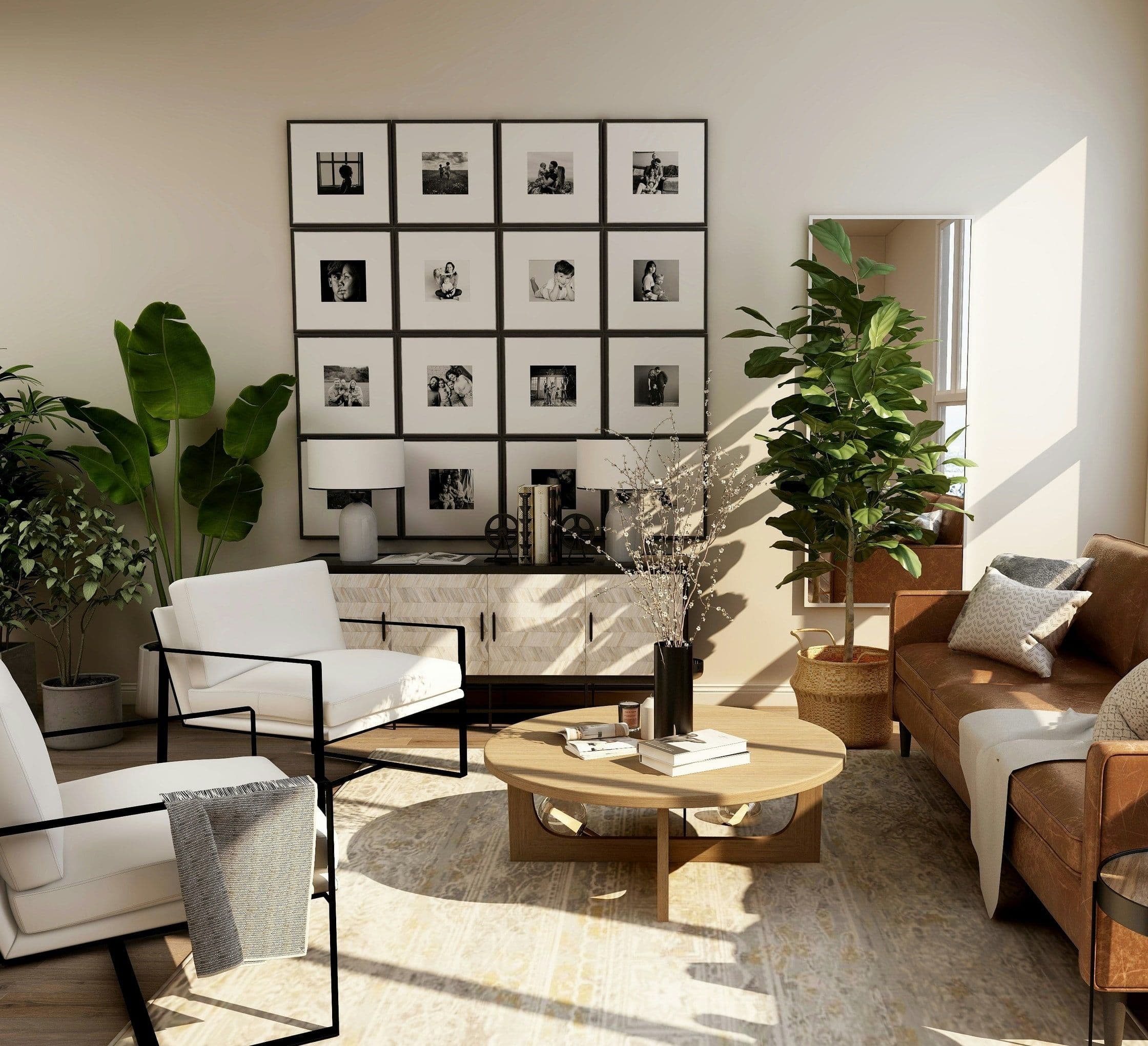
Key Highlights
No Programme
The room offers weightless seating and light that does not insist or glare.
Care as Architecture
Distance from the street and a quiet plan do more than surface treatment ever will.
Permission to Stop
The finish exists so the body can lower its guard without naming a ritual.