
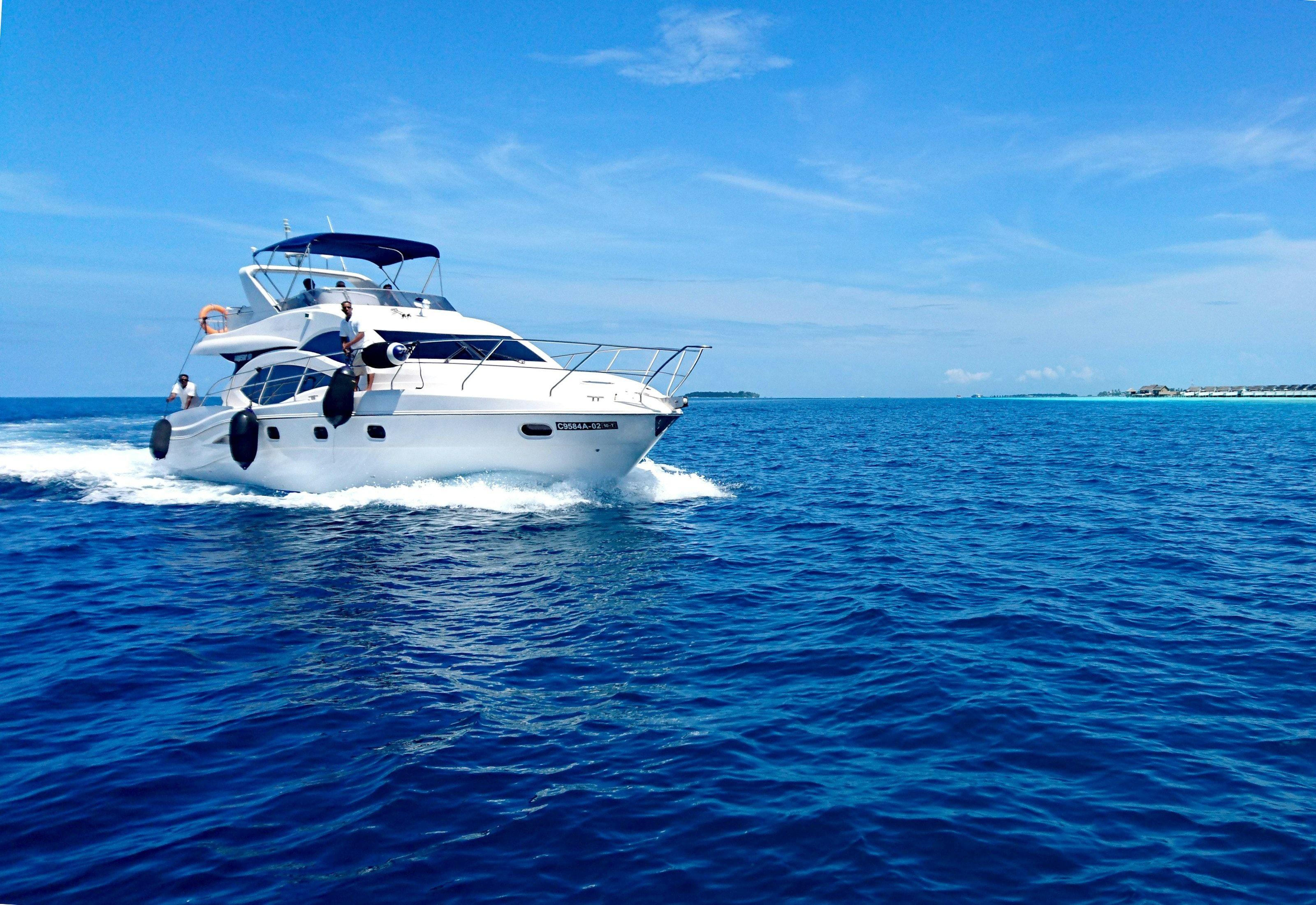
Trade winds and pale sand from December; island hops and long Italian tables from June. Travellers who already know the strongest villas and resorts often take a crewed superyacht as the next quiet step. Each morning can change the view. The programme belongs to the party. A professional crew — typically between ten and thirty — carries the detail, from the chef’s menus to tenders and the toys staged at the swim platform, so the week stays about place rather than logistics. The question desks hear first is rarely whether to charter; it is where and when. For many clients the answer settles on two seas and two seasons: Caribbean winter, Mediterranean summer. Several of the strongest charter yachts spend the year moving between those waters, so guests can follow the sun without changing vessels.
Caribbean charter water runs roughly December through April. The trades hold steady, the sea stays warm, and hurricane season sits behind. It is the natural exit from a northern winter — not a single-beach resort week, but a sequence of harbours chosen each evening. The cadence is barefoot without being careless: long days on sand, swimming or snorkeling from the stern, sunsets that need no audience. Christmas and New Year remain the calendar’s most contested weeks, and they close first.
St Barth and St Martin concentrate Caribbean glamour. Gustavia’s harbour, beach clubs, and strong restaurants set a social temperature that still lets a tender leave when privacy is preferred. Sint Maarten also functions as a principal berth for large hulls — a practical doorway as much as a destination. Antigua sits at the centre of the region’s yachting life: English Harbour’s historic ground, a coastline often tallied at three hundred and sixty-five beaches, plus a season thick with regattas and shows that draw captains and brokers into the same water. The British Virgin Islands string dozens of islands close together, with protected anchorages and shore bars reachable only by tender — geography made for short hops rather than long passages. The Grenadines keep a wilder edge; in the Tobago Cays, turtles move through water clear enough to read from the rail.
Choose the Caribbean when the week should decelerate. Snorkeling off the platform, sand that asks for little more than shade, evenings that end on the same horizon. Festive weeks require earlier decisions; some yachts also insist on longer minimum stays as December turns into January. That scarcity is operational, not theatrical. Winter simply fills while summer plans are still sketches.
Mediterranean charter months run June through September and offer what Caribbean hops cannot compress: deep history, culture, and cooking within a short cruise. Each day can open a different island, harbour, and table. Variety is the season’s real currency — a morning swim, an afternoon in a historic town, dinner at a family trattoria — without dramatic repositioning. June and September bring warm water, quieter quays, and softer rates than July and August, which remain the densest stretch for the most sought-after boats.
Sardinia and Corsica give granite inlets, Maddalena’s protected archipelago, and the social temperatures of Porto Cervo and Bonifacio, where the yacht can stay offshore while lunch happens ashore. Along the Amalfi Coast and Capri, cliff villages, lemon groves, and long midday tables are best read from the sea. The Aeolian chain and Sicily add volcanic ground, Stromboli’s night fire, and some of Italy’s strongest cooking. The French Riviera and Croatia stretch the map from Monaco and Saint-Tropez to Dalmatia’s islands — glamour on one hand, quieter stone harbours on the other, under the same summer light.
Set beside each other, the seasons clarify taste rather than rank. Caribbean window: December to April. Mediterranean window: June to September. One favours beaches, snorkeling, and unhurried island-hopping; the other favours culture, food, and landscapes that change every few hours. Atmosphere splits between barefoot ease and glamour braided with tradition. Peak pressure gathers around Christmas and New Year in the west Atlantic, and around July and August in the Med. Booking typically means six to nine months ahead for festive Caribbean weeks, and six to twelve months ahead for peak Mediterranean summer. Shoulder months — the Caribbean’s early and late season edges, the Med’s June and September weeks — remain the quieter way to hold strong water without the calendar’s sharpest competition.
Giulia Di Leo founded Your Boat Holiday (YBH), a Milan-based independent charter brokerage; she is also an individual MYBA member and has walked each of the following yachts herself. That matters because brochures flatten difference. Two hulls of similar length can deliver entirely different weeks once crew, chef, and deck culture are felt on board. The five below share a habit of tracking the sun — Caribbean or nearby winter water, Mediterranean summer — so a family can keep a relationship with one vessel across seasons.
LUNA, a ninety-metre Oceanco, takes twelve guests across seven cabins with a crew of thirty. Winter berths her in Sint Maarten; summer places her in Monaco. She reads as a floating resort kept at a personal scale: a private owner’s deck with its own salon and jacuzzi; wellness spaces including hammam, sauna, massage and beauty rooms; a glass-walled gym; a freshwater pool that supports counter-current swimming. A lift for six connects guest decks. From the beach club, toys run deep — a fifteen-metre inflatable slide, Seabobs, a Fliteboard, kitesurfing kit — backed by a Wajer 55 chase craft plus a limousine tender. Di Leo first boarded LUNA at the 2025 MYBA Charter Show in Sanremo and plans to return in Antigua this December. Her reading returns to scale without anonymity: twelve guests, thirty crew, and a Christmas week in St Barth that can feel like a private house rather than a corridor hotel on water.
CORAL OCEAN, a seventy-three-metre Lürssen, also hosts twelve guests in seven cabins, with twenty-four crew. Winter programmes cover the Caribbean and the Bahamas; summer returns her to the Mediterranean. The yacht carries Jon Bannenberg’s celebrated lines, thoroughly reinvented: a broad main deck shaped for gatherings, with a shell door that draws the salon open to the sea, and an owner’s suite with a private deck and views spanning roughly one hundred and eighty degrees. A wellness and activity team can add a trainer, Pilates instructor, diving instructor, and videographer — support that keeps a week active without importing a separate land staff. Di Leo reviewed her at the 2026 MYBA Charter Show in Sanremo and will board again in Antigua this December, keeping the winter reading as current as the summer one.
ALVA is a sixty-metre Amels for twelve guests in six cabins with thirteen crew, and ranks among the newer charter names for Caribbean winter 2026/27. Harrison Eidsgaard shaped the interiors; Espen Øino the exteriors. From the owner’s suite, a terrace folds down to the waterline. Sauna and ice bath sit in the beach club. An 8.6-metre Pascoe Beachlander can land guests straight onto sand — a practical advantage when beach days are the week’s true programme rather than a single afternoon ashore.
LUMIERE, a fifty-metre Benetti B.Now Oasis, sleeps twelve across six cabins with ten crew. Winter water includes the British Virgin Islands and the Bahamas; her 2027 summer already leans toward Sardinia. The Oasis Deck is the signature: more than one hundred square metres of beach club where fold-out terraces surround a pool set just above the waterline. In the BVI, that deck turns each anchorage into a private beach club without needing a shore reservation. The Sardinia summer calendar is already forming — another reminder that the strongest Med weeks close early.
SEAWOLF X is a forty-three-metre Rossinavi hybrid catamaran for twelve guests in five cabins with nine crew. Antigua anchors her winter; Mediterranean summer includes an expected July presence on the Amalfi Coast. She is the most technically distinct of the five: a hybrid-electric platform able to hold silent mode at anchor for as long as twenty-four hours. Twin hulls hold a lounge of about one hundred square metres and a garage of toys that runs from e-foils to underwater jetpacks. A fifteen-metre chase boat with its own crew travels with the charter, extending range without enlarging the mothership’s wake.
Di Leo’s counsel stays usefully plain. Caribbean and Mediterranean weeks are different holidays; both reward the right party. In the Caribbean, guests arrive to slow down — beach days, snorkeling, sunsets that do not compete with a city’s calendar. In the Mediterranean, each day can change island, table, and harbour. Many of her clients do both: one week in winter, one in summer, often returning to the same yacht so crew familiarity becomes part of the luxury. December takes her to Antigua for that island’s Charter Yacht Show, where she boards LUNA and CORAL OCEAN again and inspects further hulls for winter. Standing on deck, speaking with the captain, and sampling the chef’s cooking, she notes, tells more than any brochure. Matching crew culture to a family, a couple, or a group of friends is as decisive as matching length or toy list.
Planning follows scarcity rather than impulse. Reserve festive Caribbean weeks early; Christmas and New Year dates often lock months ahead, and some yachts require longer minimum stays. Mediterranean peak summer — July and August — fills six to twelve months ahead on the most sought-after vessels. Shoulder seasons remain the intelligent alternative when privacy outweighs festival energy: late opening and late closing months in the Caribbean, early and late summer weeks in the Med. Choose the crew with the same care as the yacht. A broker who has stood on the deck can say which teams suit children, which prefer adult tables, and which keep a quieter house overnight.
Whether the next held week points toward St Barth in winter or the Amalfi Coast in summer, the useful frame is not rivalry between oceans. It is sequence. Winter water, then summer water — sometimes on one yacht that follows the sun, sometimes on two carefully chosen hulls. The Caribbean offers sand, clarity, and a slowed pulse. The Mediterranean offers harbours thick with history and tables that change with each island. Selection decides which season comes first; the charter desk’s work is to keep the vessel, the crew, and the calendar aligned so that the week remains private, coherent, and free of noise that does not belong on the water.
Key Highlights
Two Seasons
Caribbean December–April for slowed beaches; Mediterranean June–September for shifting harbours.
Book the Peaks Early
Festive Caribbean weeks and July–August Med calendars close first.
Crew Before Length
A broker who has stood on deck can match house culture to the party.
Explore more
Travel
Nile Under a Held Sun
EYOS Expeditions times a ten-day Nile dahabiya to the August 2027 eclipse — private dawn at Giza, special tomb access, and a mid-river vantage for totality.
Property
Timber Above the Snow Line
A chalet held for the season’s silence, where the house is a climate rather than a view listing.

Food & Drink
Morning Coffee as Protocol
The first cup as a private sequence — grind, water, pause — before the day is allowed to speak.