
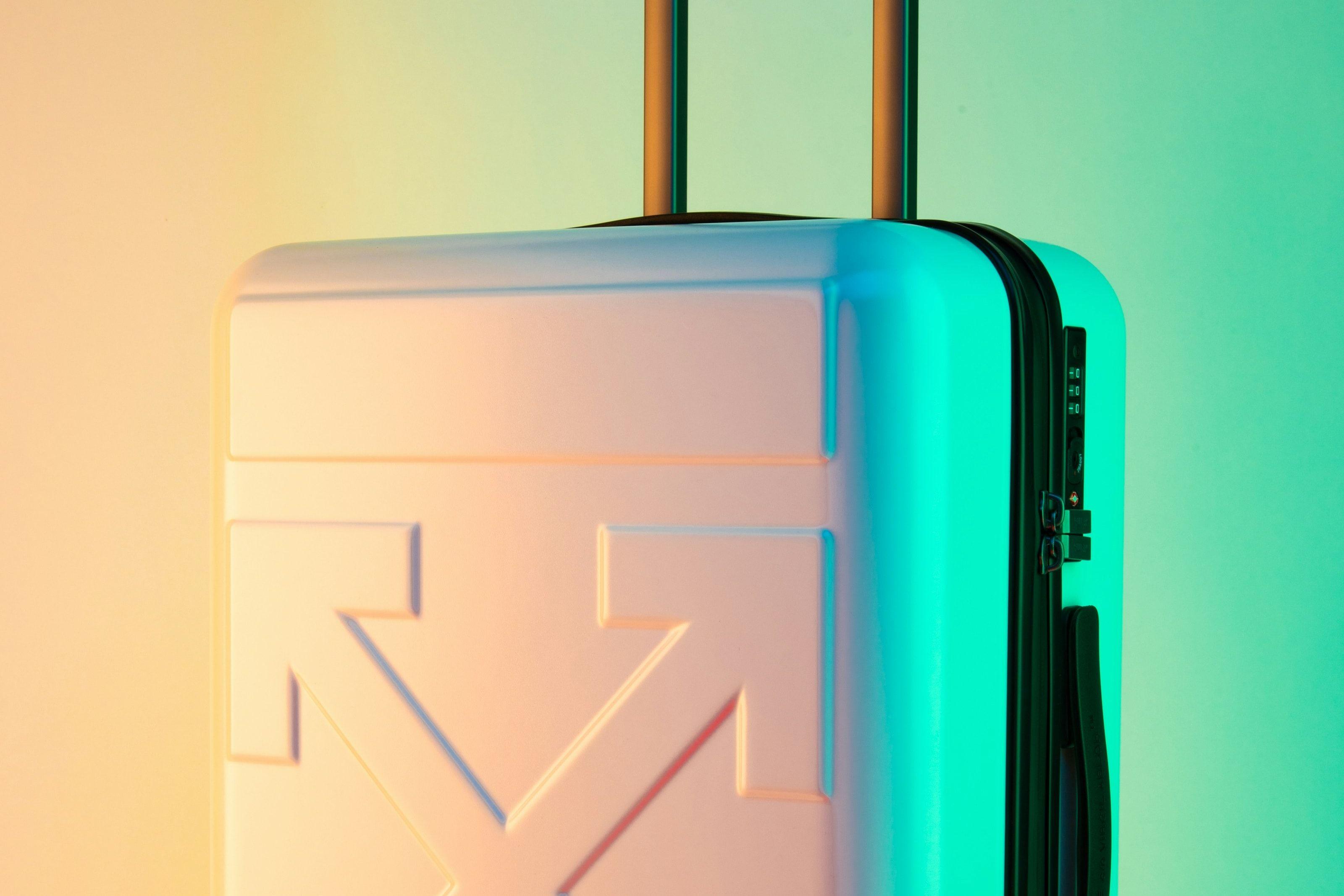
White, on luggage, is usually a dare. It asks the case to stay unmarked, to refuse the corridor and the carousel. Maison Margiela has always understood white differently: not as a finish that denies use, but as a surface designed to keep a record of it. Rimowa has long taken a related view of its aluminium shells — that a dent, a scuff, a sticker left behind after a crossing is less damage than evidence. Their new collaboration sits exactly where those two readings meet. Paint cracks. Ridges hold dust. The set is meant to learn the journey rather than erase it.
The white that matters here has a date and a room. In 1988, Martin Margiela and Jenny Meirens — co-founder of the house that still carries his name as Maison — painted their entire studio white. Furniture went under the brush. Some pieces were draped in white cotton as well. Mannequins received the same coat. The decision was largely financial: a way to pull cohesion from an uneven mix of second-hand pieces gathered from markets and thrift rooms. What they enjoyed, beyond thrift, was the future of that surface. Paint would scuff and peel. Objects would patina. Traces of what they once were would return through the white, not despite it.
That studio habit became bianchetto — whitewashing as a house technique. Pieces from collections were hand-painted white, made so the coat will fracture and soften with years, until use shows through the white. Bianchetto sits with anonymity, deconstruction, and the Tabi among Margiela’s foundational codes. It is perhaps best known on the Tabi itself: footwear that follows the traditional Japanese split-toe tabi form. Bianchetto first appeared in 1989 on an early Tabi boot. The paint was never meant to stay perfect. It was meant to keep company with wear.
Under Belgian designer Glenn Martens, that code now meets German luggage house Rimowa. The collaboration turns on two forms: Rimowa’s Classic Cabin — the familiar aluminium fluting now under a white hand-coat — and Maison Margiela’s 5AC XL travel bag, likewise finished in bianchetto and reshaped so sculpted leather channels answer those flutes. Those ridges, on Rimowa’s side, were drawn, at origin, from the language of airplane fuselages — an industrial memory carried into cabin scale. The leather translation is not costume. It is a quiet rhyme between soft goods and hard shell, house and house, without asking either object to abandon its own grammar.
Both houses frame the set around a lived-in ethic. Rimowa’s cases leave the line in technical perfection, then welcome what travel does next. Aluminium in an ever-growing array of hues will dent and scuff; the house has long treated those marks as mementos rather than failures. Stickers and tags have been encouraged for the same reason: the case becomes a private map of crossings. Maison Margiela arrives at a similar honesty through bianchetto, and through clothes that open torn layers so construction and linings stay visible. Lived-in, here, is not a marketing softener. It is a shared refusal of the object that pretends never to have been handled.
The Classic Cabin in this reading carries that refusal into its interior as well. The lining is white. Stitches remain visible. Edges interlock in a way that makes the case read as if turned inside out — a Margiela habit of showing what most luggage hides. The traditional logo plaque is closed with four white stitches — the house’s quiet mark in place of logos or monograms. Nothing shouts at the carousel. The identification is for those who already know how to look, which is the only audience quiet luggage needs.
The 5AC XL bag completes the set with its own architectural joke kept serious. Its build suggests the lining drawn outward from the mouth of the bag — another inside-out gesture, soft rather than ridged. Leather loops, removable when needed, let the bag ride the Classic Cabin’s telescopic handles, so the two travel as a single thought rather than as matching merchandise. The grooves in the leather keep Rimowa’s fuselage memory in the hand even when the aluminium is resting elsewhere. White paint on both pieces will crack and fade on different schedules: leather flexes; aluminium takes knocks. The collaboration counts on that difference. Patina is not a single event.
A campaign film, conceived by Dexter Lander, places the set in a traditional Haussmannian apartment in Paris, Maison Margiela’s home city. White paint falls in a slow spray across luggage and rooms, then leaves wall imprints of the bag and suitcase silhouettes. The film is playful without becoming a joke about ownership. It returns the viewer to the 1988 studio: white as a decision about cohesion and time, not as a pristine product shot. What remains on the wall is outline — the shape of travel after the paint has done its work.
The set enters Rimowa and Maison Margiela spaces on 19 November 2026. That date is a threshold more than a shop window: afterward the white begins its private career with whoever carries it. The desk reading stays with finish and use — the scuff that reveals aluminium, the crack that shows leather grain, the four stitches that refuse a monogram’s noise.
Luggage that learns white is luggage that accepts the corridor. Airports are strip light and urgency; quiet cases do not compete with either. They take the knock of a seat rail, the drag across stone, the soft compression of being stacked beside a coat. Margiela’s bianchetto and Rimowa’s embrace of travel marks meet in that ordinary violence. The paint was never the point. The revealing was. What the set offers the Beyondaries reader is a finished object that still knows how to become unfinished — honestly, slowly, and without asking for an audience when the cracks finally arrive.
There is a kinship between this collaboration and any material that travels without announcement: leather that darkens at the handle, aluminium that keeps a map of platforms, cloth that refuses a logo at the gate. Selection here is not scarcity theatre. It is the decision to carry something already prepared to age in public while remaining private in meaning. The Haussmannian walls in Lander’s film keep silhouettes; the owner keeps the hours. Between those two records — imprint and use — the white does its quiet work.
Glenn Martens’s Maison Margiela keeps the older codes in play — anonymity, deconstruction, Tabi, bianchetto — each a way of showing and withholding. Rimowa keeps the fuselage ridge and the belief that a perfect shell is only the start of a case’s life. Their meeting is precise because it is narrow: one technique, two objects, a shared patience with marks. When the paint finally gives, it will look less like failure than like 1988 returning through cabin scale — Jenny Meirens and Martin Margiela’s studio lesson still teaching the surface what to do with time.
Key Highlights
Bianchetto as Record
White paint finished to crack and fade, so use returns through the surface.
Lived-In Agreement
Rimowa’s travel marks and Margiela’s inside-out codes share one patience with wear.
Cabin and 5AC
Classic Cabin and sculpted 5AC XL travel as one thought from 19 November 2026.
Explore more
Style
Wrist and Road: Where Horology Meets the Collector Car
A short intelligence map of how watch collecting and automotive desire reinforce each other — finish, patience, and private use.

Motor
The Bay Left Open
A garage ritual that is not display: space kept for the machine that will leave before dawn.

Health & Beauty
Rooms That Soften the Day
Light, material, and care taken as architecture — rooms that soften the day without a brochure.